Planning a field service week without the Friday panic
A practical weekly planning routine for small field service teams: capacity, travel, skills, parts and the jobs that always appear on Thursday afternoon.
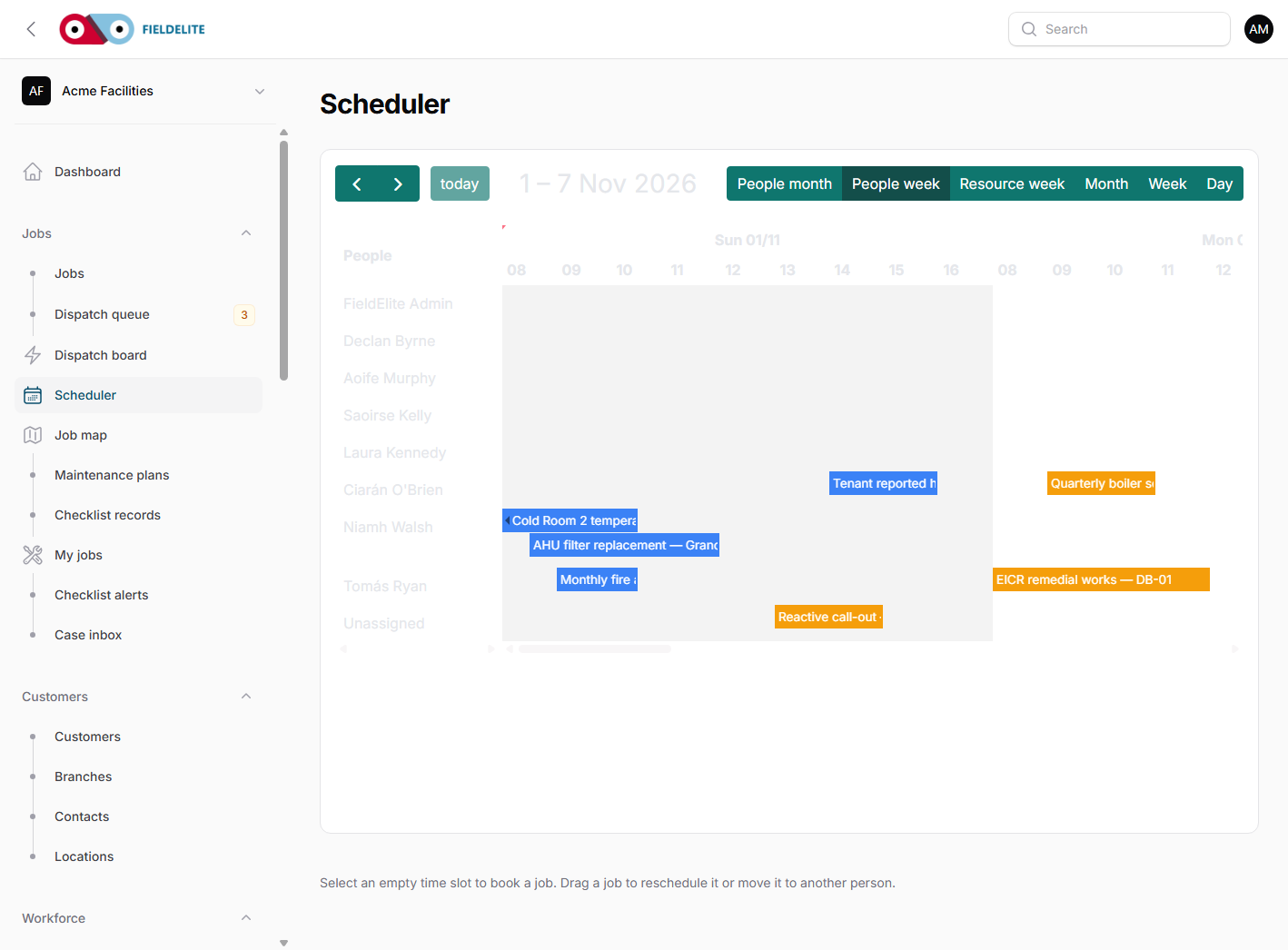
Most field service weeks are planned twice. Once on Monday, when the schedule looks sensible, and again on Thursday afternoon, when three urgent jobs arrive and the week falls apart.
A better routine does not remove emergencies. It leaves room for them.
Start with the real capacity
Do not count a technician as eight available hours if two of them are travel and one is a scheduled break. Use the working day, the depot, the van and the travel time between sites.
Look at last week's actual completion times, not the estimate on the job. If a boiler service is booked for 60 minutes and usually takes 95, the schedule is already wrong.
Group the work by geography
A day of jobs in one town is usually better than three jobs across three counties. The scheduler should make travel visible before the dispatcher commits the visit. If the travel time is longer than the job, ask whether the visit can move.
Check the skill and the part
The right engineer without the right part is still a return visit. For planned work, check the parts and the calibration before the day starts. For reactive work, make the parts question part of the dispatch decision.
Leave a buffer
A full day with no gaps is not efficient. It is a promise that nothing will go wrong. Leave a realistic buffer for the call-outs, the access delays and the job that takes longer than the last one.
Review the week on Friday
- Which jobs moved more than once?
- Which visits needed a second trip?
- Where did travel eat the day?
- Which customer changed the scope after the quote?
- What should be planned differently next week?
The point is not a perfect plan. It is a plan that can absorb the work that arrives after it was made.
Related: Job scheduling · Scheduling and dispatch help

Declan has run field service teams in facilities and mechanical maintenance for more than 15 years. He writes about scheduling, handovers and the admin that grows around a job.